
AI Basics & History05 Nov 2026
The AI Era: The Complete Series Guide
One page that lists every post in The AI Era series, grouped by theme, with a short method for checking any AI claim yourself.
By Faisal Adnan
Faisal Adnan · 05 Nov 2026
Whenever people talk about AI and war, two very different things get mixed together. One is AI helping people analyse information. The other is machines deciding by themselves whom to attack. They are not the same, and the difference between them is one of the most important debates of the decade. A useful way to think about it is a ladder with four levels.
Key takeaways
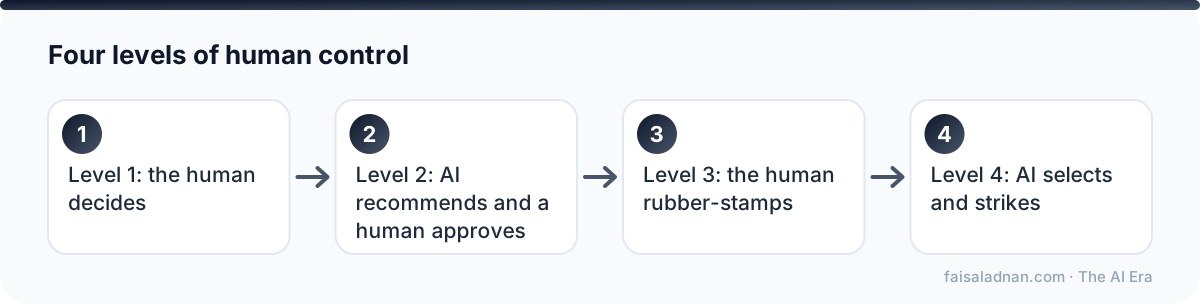
AI analyses drone video, satellite images and intercepted data. People choose every action. Project Maven, which the US military has run since 2017, began as this kind of system. Lawfare's review of Katrina Manson's book "Project Maven" describes how the programme grew into the military's best-known AI effort. At this level AI is like a very fast assistant that reads more footage than any team of analysts could.
The system proposes and ranks targets, and a human approves each one. It has been reported that Claude was embedded in Palantir's Maven Smart System in this role. The human still has a real choice, as long as they have time and information to make it.
A person is technically in the loop but has only seconds to decide. The reported example is "Lavender", an Israeli system described by +972 Magazine, where an officer said they reviewed each target for around 20 seconds. These accounts come from journalism and anonymous sources, not official records, so please treat them as reported claims, and they are disputed.
The system chooses and engages targets without a human decision for each strike. These are lethal autonomous weapons, the subject of the "killer robots" debate at the United Nations.
Human Rights Watch reported in September 2026 that the final session of the Group of Governmental Experts under the Convention on Certain Conventional Weapons ended with calls for negotiations growing. States showed a commitment to move towards negotiations on a legally binding instrument, although HRW said the final report did not fully reflect the progress made.
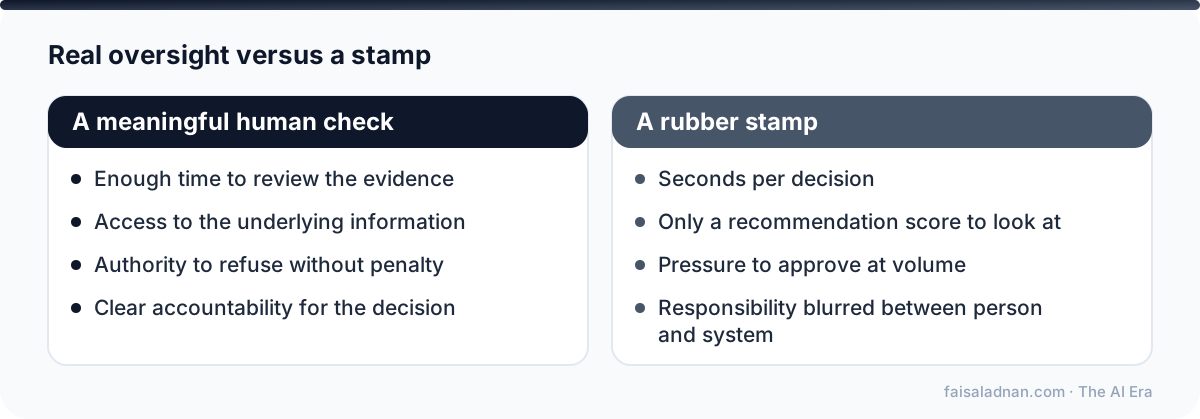
Is a human really "in the loop" if they only have 20 seconds? A person who must approve targets at machine speed may add little more than a stamp of approval. The difference between level 2 and level 3 is not the software. It is whether the human has time, information and the authority to say no.
These questions apply well outside the military. A hospital that lets an AI score patients, a bank that lets it approve loans and a company that lets it rank job candidates all face the same ladder. Read how one company drew its own lines in Anthropic's two red lines and the Pentagon, and what reporting says about AI on real battlefields.
See the complete AI Era series

Written by Faisal Adnan
Business Intelligence and AI mentor. I teach Data Analytics, Power BI, Microsoft Fabric, SQL, Python and applied AI, and write about what is changing and what it means for your career.

Written by
Faisal Adnan is a data analytics and AI mentor from Pakistan. He teaches Power BI, Microsoft Fabric, machine learning and applied AI through live classes and 1-on-1 mentorship, and writes in plain language so students and working professionals can follow where AI is heading and what to learn next.
One page that lists every post in The AI Era series, grouped by theme, with a short method for checking any AI claim yourself.
By Faisal Adnan

Free tools to test AI apps, scan them for security problems and learn how models are built, including Playwright, promptfoo, garak, PyRIT, Semgrep and Karpathy's nanochat. Plus a starter plan.
By Faisal Adnan

Open-source tools for no-code AI apps, image and video generation and speech, including Urdu transcription with Whisper, plus a licence warning every builder should read.
By Faisal Adnan