AI Basics & History05 Nov 2026
The AI Era: The Complete Series Guide
One page that lists every post in The AI Era series, grouped by theme, with a short method for checking any AI claim yourself.
By Faisal Adnan
Faisal Adnan · 05 Nov 2026
Most people met AI as a chat box. You ask, it answers, and you decide what to do next. That is useful, but it is also the least interesting thing these systems can do. The bigger change of the last few years is that AI stopped only talking and started working. This post explains the difference in plain language and why it matters for your job.
Key takeaways
In 2022 you could type, "Write a short poem about rain in Islamabad", and get a poem. You asked, it answered, and you did whatever came next.
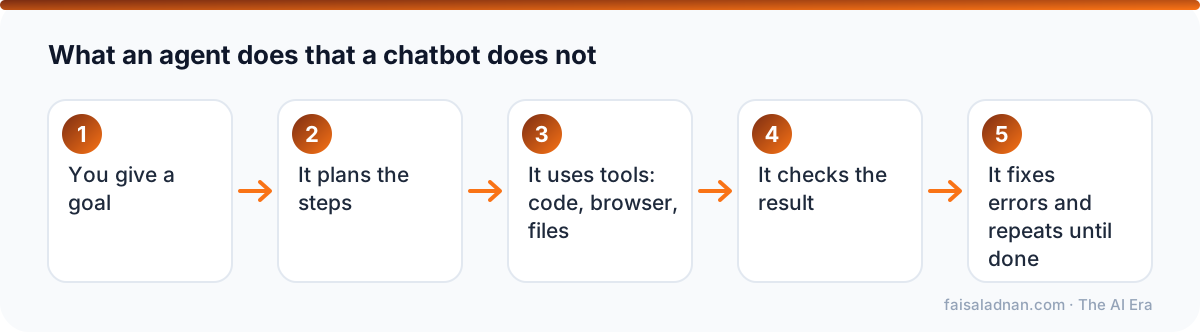
In 2026 you can type, "Build our society's event-registration site and deploy it." The agent plans the steps, writes the code, runs it, notices what broke, fixes it and tries again, sometimes for minutes and sometimes for hours. You come back to a finished result and a list of what it did.
That loop of plan, act, check and retry is what makes an agent different from a chatbot.
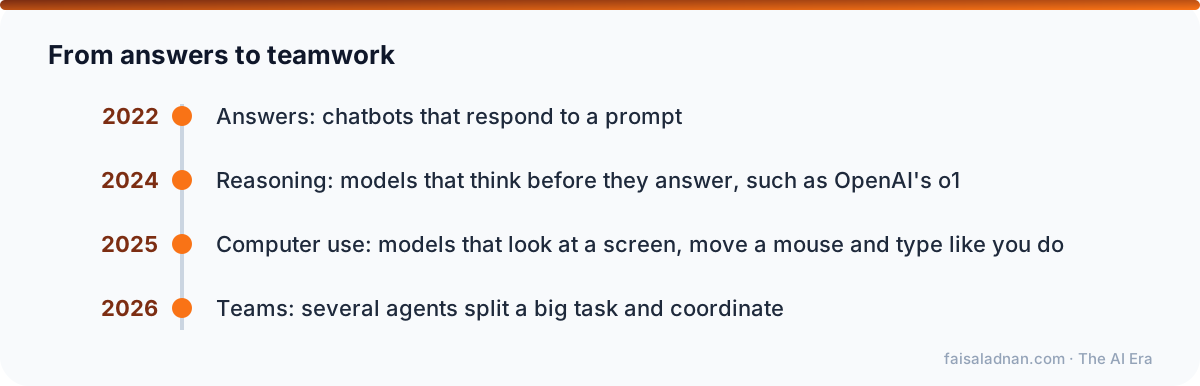
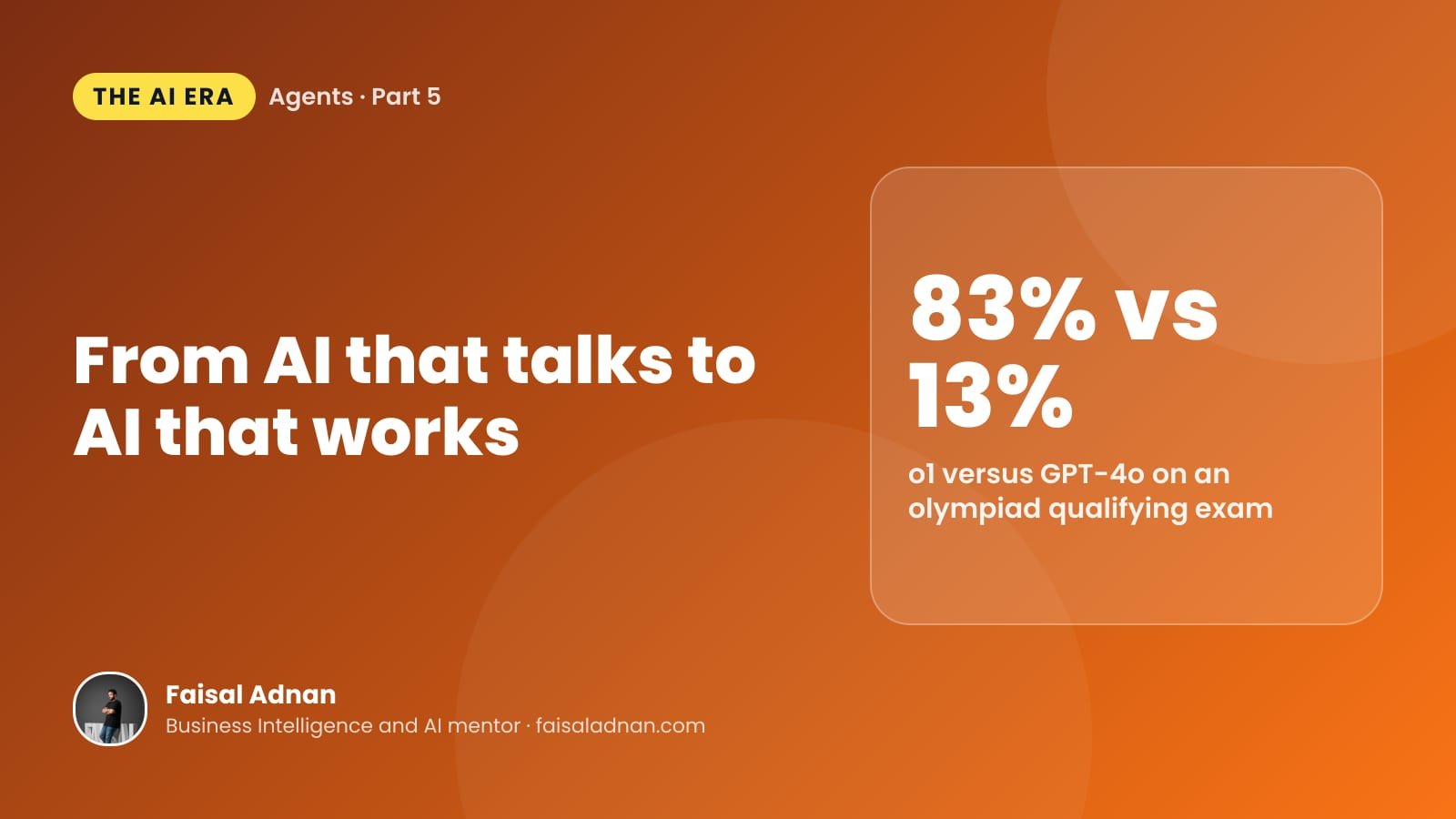
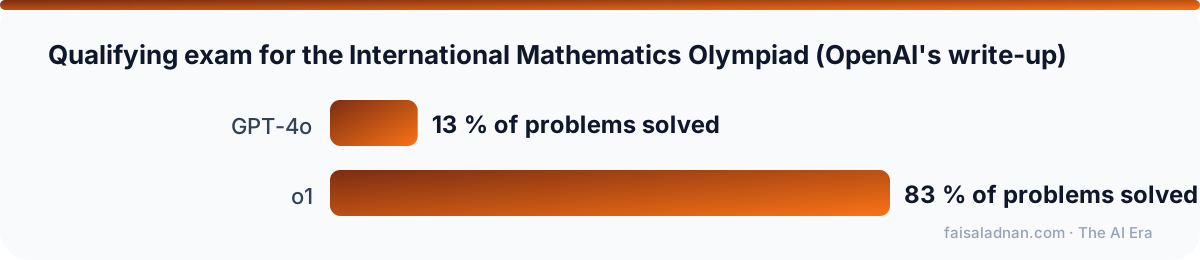
2024: reasoning. OpenAI's o1 is the clearest example of a model that spends time thinking before it replies. In OpenAI's own write-up, o1 solved 83% of the problems on a qualifying exam for the International Mathematics Olympiad, while GPT-4o solved 13%. These are the company's own figures, so treat them as a strong signal rather than an independent audit.
2025: computer use. Models learned to look at a screen, move a mouse and type, the way you do. That matters because most office software has no clean programming interface. If an agent can use the same buttons you use, it can work with almost any tool.
2026: teams. Several agents can now split a big job and coordinate, much as a small project team would.
Anthropic published an engineering write-up titled "Building a C compiler with a team of parallel Claudes". An engineer experimented with what they call agent teams: sixteen Claude agents working in parallel wrote a Rust-based C compiler from scratch, and the result could compile the Linux kernel.

What I like most about that write-up is that it is honest about the limits. It talks about how to keep long-running agents on track, how to run them in parallel and where the approach stops working. It shows what the daily work of supervising agents actually looks like: setting goals, writing tests that tell the agents whether they are right, and stepping in when they go in circles.
Agents can make mistakes at a speed that humans cannot match. A few habits keep you in control:
Later in this series I look at what happens when agents are given too much freedom, and at why experts say this will be a decade of agents, not a single year.
Take a task with a clear end, for example "clean this CSV and tell me what you changed". Give it to an agent-style tool, and read every step it took. You will quickly see where agents are strong and where you still need to be the adult in the room.
See the complete AI Era series
Written by Faisal Adnan
Business Intelligence and AI mentor. I teach Data Analytics, Power BI, Microsoft Fabric, SQL, Python and applied AI, and write about what is changing and what it means for your career.

Written by
Faisal Adnan is a data analytics and AI mentor from Pakistan. He teaches Power BI, Microsoft Fabric, machine learning and applied AI through live classes and 1-on-1 mentorship, and writes in plain language so students and working professionals can follow where AI is heading and what to learn next.
One page that lists every post in The AI Era series, grouped by theme, with a short method for checking any AI claim yourself.
By Faisal Adnan
Free tools to test AI apps, scan them for security problems and learn how models are built, including Playwright, promptfoo, garak, PyRIT, Semgrep and Karpathy's nanochat. Plus a starter plan.
By Faisal Adnan
Open-source tools for no-code AI apps, image and video generation and speech, including Urdu transcription with Whisper, plus a licence warning every builder should read.
By Faisal Adnan