AI Basics & History05 Nov 2026
The AI Era: The Complete Series Guide
One page that lists every post in The AI Era series, grouped by theme, with a short method for checking any AI claim yourself.
By Faisal Adnan
Faisal Adnan · 05 Nov 2026
If you are about to graduate or have just graduated, this is probably the most personal post in the series. The evidence suggests that AI is affecting jobs unevenly, and that people at the start of their careers feel it first. Here is what the research says, and what you can do about it.
Key takeaways
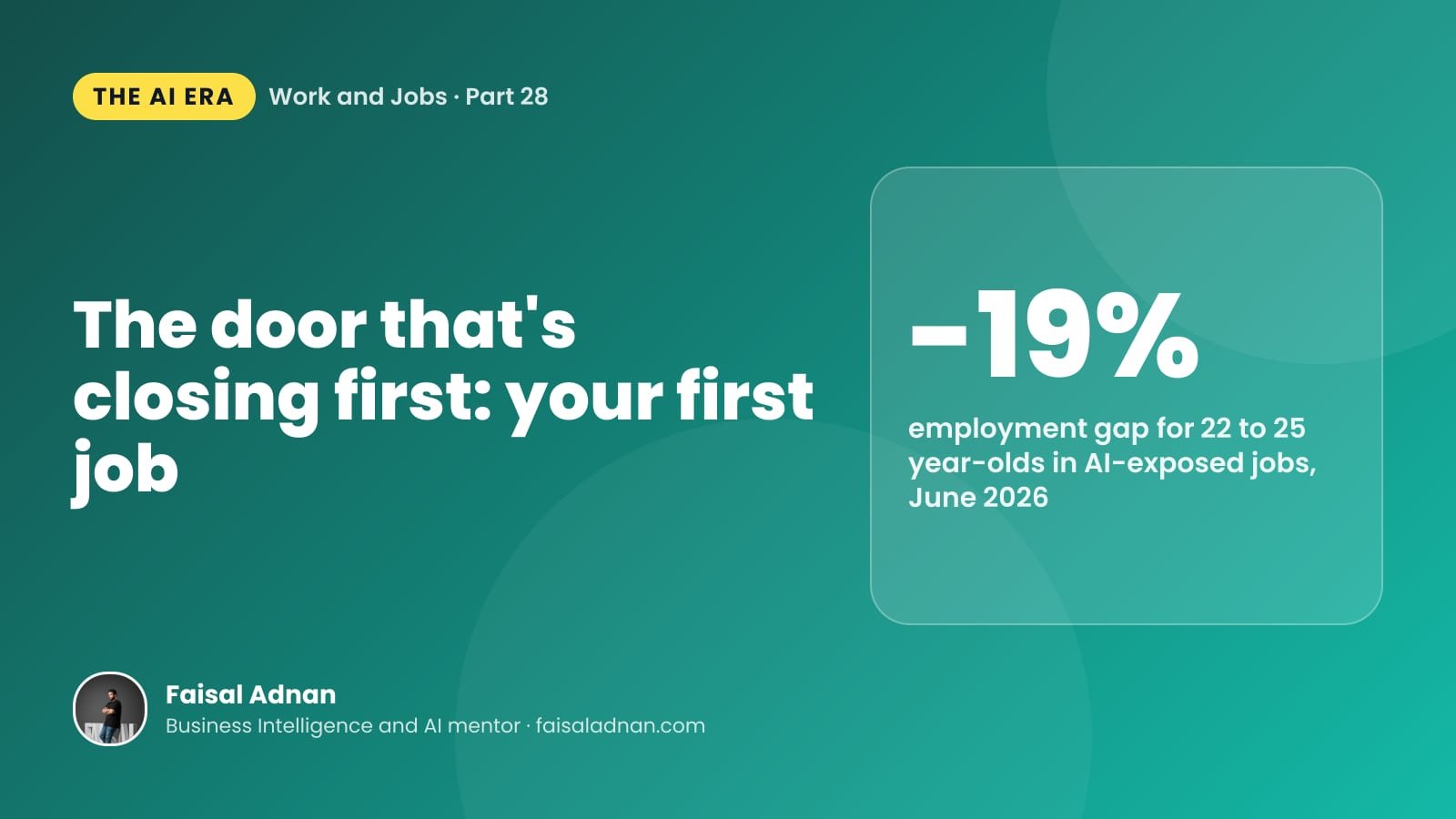
The Stanford Digital Economy Lab published an August 2026 update to its "Canaries in the Coal Mine" research, using ADP payroll data. It compared the employment of 22 to 25 year-olds in highly AI-exposed jobs against peers in less-exposed jobs. In July 2025 the gap was 15%. By June 2026 it had widened to 19%. For experienced workers, there was no comparable gap.
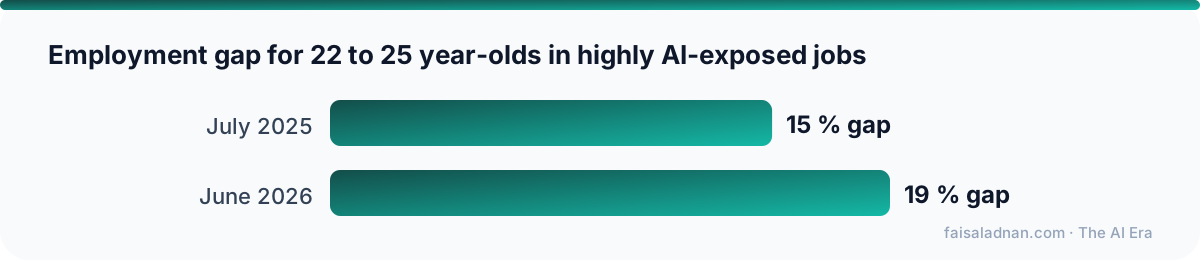
The headline is careful: no widespread displacement, but the AI employment gap for young workers has widened. That is an honest summary. The sky is not falling for everyone, but the first rung of the ladder is getting harder to reach.
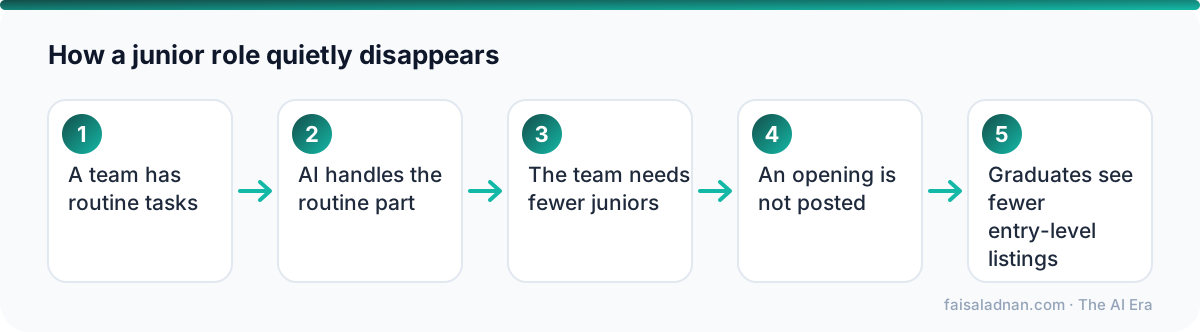
It does not look like mass firing. Companies simply hire fewer juniors. Where AI automates tasks, those jobs shrink. Where AI augments people, employment is flat or rising.
Juniors are hired for codified knowledge: the things in textbooks and courses. That is exactly what AI is good at. Tacit knowledge, such as judgment, experience and knowing how an organisation works, is gaining value. An experienced analyst knows which number looks wrong. That is hard to learn from a course.
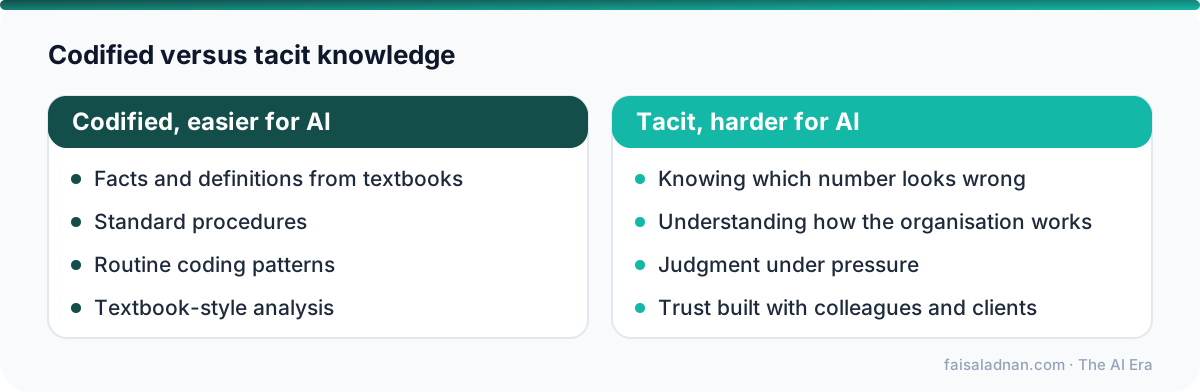
The New York Fed reported that computer engineering graduates in the US have an unemployment rate of 7.8%, the second highest among college majors, as VnExpress reported. The World Economic Forum published a briefing on AI and entry-level jobs in January 2026 that looks at the same issue.
These are US numbers, and the Pakistani market differs. But many Pakistani graduates compete for remote and multinational work, so the pressure travels.
None of this means a degree is useless. It means a degree alone is a weaker signal than it used to be. Pair it with evidence that you can do real work.
If you want a structured, zero-cost way to start building those skills, read the free AI learning roadmap. For the broader picture of how tasks and roles are changing, see Shrinking Tasks Versus Growing Roles.
See the complete AI Era series

Written by Faisal Adnan
Business Intelligence and AI mentor. I teach Data Analytics, Power BI, Microsoft Fabric, SQL, Python and applied AI, and write about what is changing and what it means for your career.

Written by
Faisal Adnan is a data analytics and AI mentor from Pakistan. He teaches Power BI, Microsoft Fabric, machine learning and applied AI through live classes and 1-on-1 mentorship, and writes in plain language so students and working professionals can follow where AI is heading and what to learn next.
One page that lists every post in The AI Era series, grouped by theme, with a short method for checking any AI claim yourself.
By Faisal Adnan
Free tools to test AI apps, scan them for security problems and learn how models are built, including Playwright, promptfoo, garak, PyRIT, Semgrep and Karpathy's nanochat. Plus a starter plan.
By Faisal Adnan
Open-source tools for no-code AI apps, image and video generation and speech, including Urdu transcription with Whisper, plus a licence warning every builder should read.
By Faisal Adnan