AI Basics & History05 Nov 2026
The AI Era: The Complete Series Guide
One page that lists every post in The AI Era series, grouped by theme, with a short method for checking any AI claim yourself.
By Faisal Adnan
Faisal Adnan · 05 Nov 2026
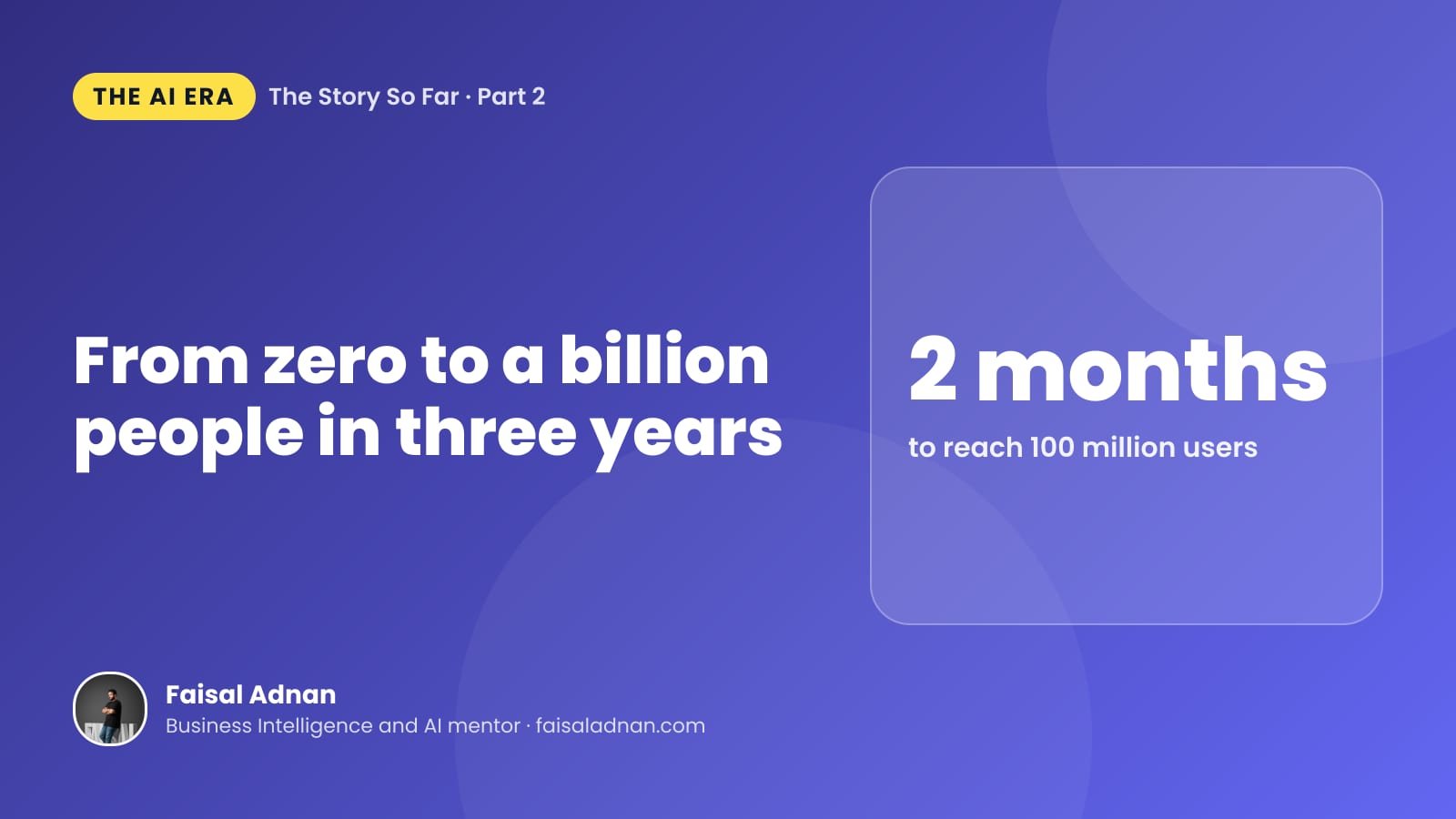
Every technology has a launch story. The telephone took decades to reach a majority of homes. The web needed years of cables, browsers and dial-up modems. ChatGPT needed a web page. This post looks at how quickly it spread, what the numbers can and cannot tell us, and why the speed itself is part of the story.
Key takeaways
The comparison comes from a UBS analysis that Reuters reported in February 2023. It called ChatGPT the fastest-growing consumer application in history, reaching an estimated 100 million monthly active users about two months after its launch in late November 2022. The same note put TikTok at around nine months to reach that number and Instagram at about two and a half years.
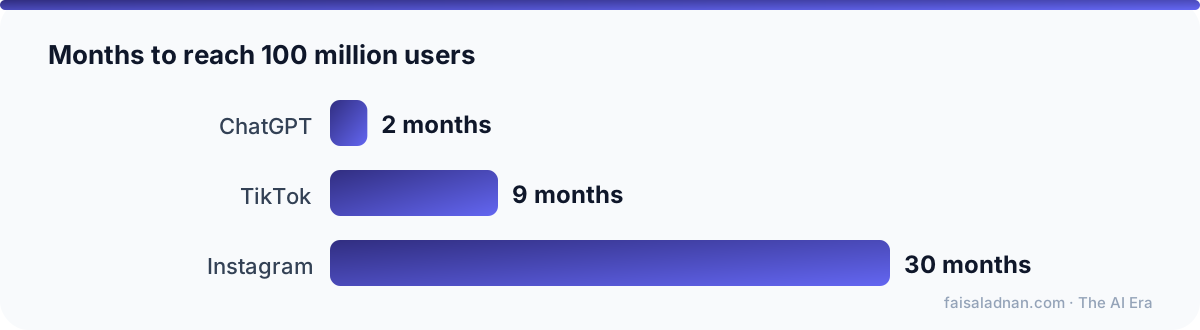
It is worth saying plainly that these are analyst estimates, not audited figures. They are widely quoted because nothing else measured the same thing in the same way. I treat them as a good indication of scale rather than a precise ranking, and I would encourage you to do the same with any league table that compares products from different eras.
Most consumer apps need something from you before they work: a download, an account, a friend who is already on it. ChatGPT asked for almost nothing. You typed a sentence and got a reply that looked like it came from a patient expert. There was no learning curve to climb, which is rare for a powerful tool.
A few other ingredients mattered:
The part people forget is what happened after the first spike. Three reported data points tell the story:
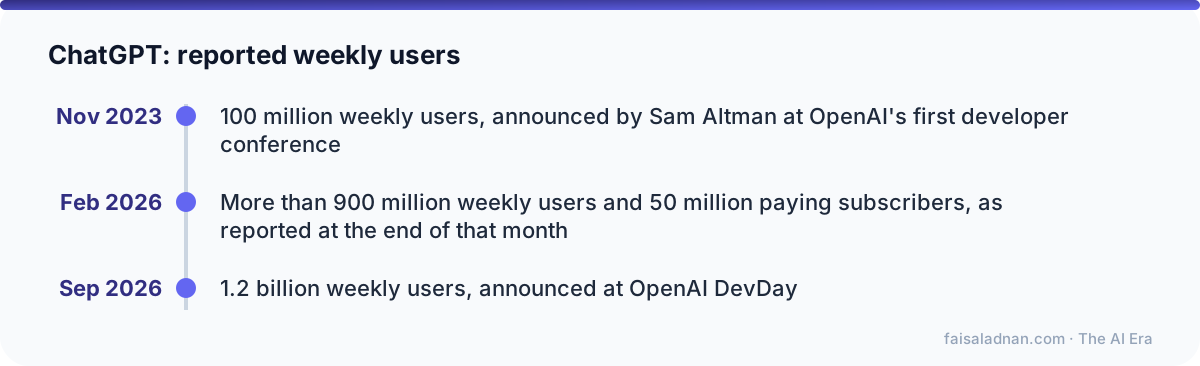
Again, I only plotted points that were reported. I did not draw a smooth line between them, because that would imply data I do not have.
Notice that the early comparison uses monthly users and the later numbers use weekly users. Weekly is a stricter measure, so the later growth is, if anything, more impressive than the headline suggests. Still, a user who opens the app once is counted as a user. Reach is not the same as value, and it is not the same as trust.
Three questions help whenever you see an adoption chart:
Paying subscribers are a useful reality check. The February 2026 report of 50 million paying subscribers shows that a meaningful share of people value the tool enough to pay, even though most users stay on the free tier.
If you want to see how we got to a world where this was even possible, read the short history from Turing to the Transformer. And if you want the bigger picture of what the numbers mean for you personally, start with You Are Not Early and You Are Not Late.
See the complete AI Era series

Written by Faisal Adnan
Business Intelligence and AI mentor. I teach Data Analytics, Power BI, Microsoft Fabric, SQL, Python and applied AI, and write about what is changing and what it means for your career.

Written by
Faisal Adnan is a data analytics and AI mentor from Pakistan. He teaches Power BI, Microsoft Fabric, machine learning and applied AI through live classes and 1-on-1 mentorship, and writes in plain language so students and working professionals can follow where AI is heading and what to learn next.
One page that lists every post in The AI Era series, grouped by theme, with a short method for checking any AI claim yourself.
By Faisal Adnan
Free tools to test AI apps, scan them for security problems and learn how models are built, including Playwright, promptfoo, garak, PyRIT, Semgrep and Karpathy's nanochat. Plus a starter plan.
By Faisal Adnan
Open-source tools for no-code AI apps, image and video generation and speech, including Urdu transcription with Whisper, plus a licence warning every builder should read.
By Faisal Adnan