AI Basics & History05 Nov 2026
The AI Era: The Complete Series Guide
One page that lists every post in The AI Era series, grouped by theme, with a short method for checking any AI claim yourself.
By Faisal Adnan
Faisal Adnan · 05 Nov 2026
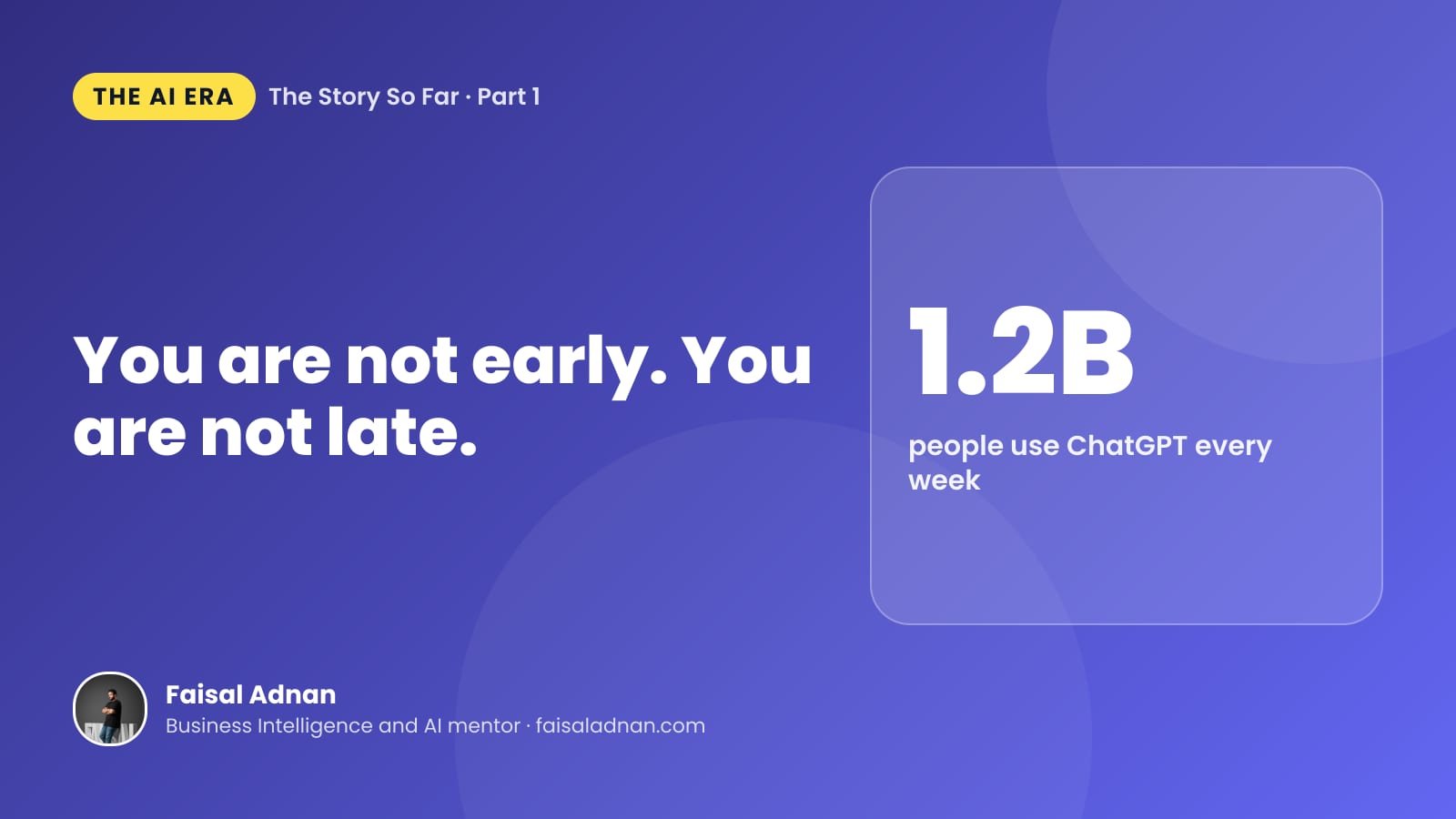
Think about the last time you opened a chat window, asked it a question and got a useful answer. A few years ago that would have sounded like science fiction. Today it is ordinary, and ordinary things deserve a proper look. If almost everyone around you already uses AI, are you late to the party? Or is it so early that nobody really knows what they are doing yet? My honest answer is neither. You are not early, and you are not late. Here is the evidence.
Key takeaways
In November 2023, at OpenAI's first developer conference, Sam Altman announced that ChatGPT had 100 million weekly active users. At OpenAI's DevDay in September 2026 the number he gave was 1.2 billion people every week. That is a twelve-fold jump in under three years, and it happened without a new device, a new network or a company licence. People simply opened a browser or an app.
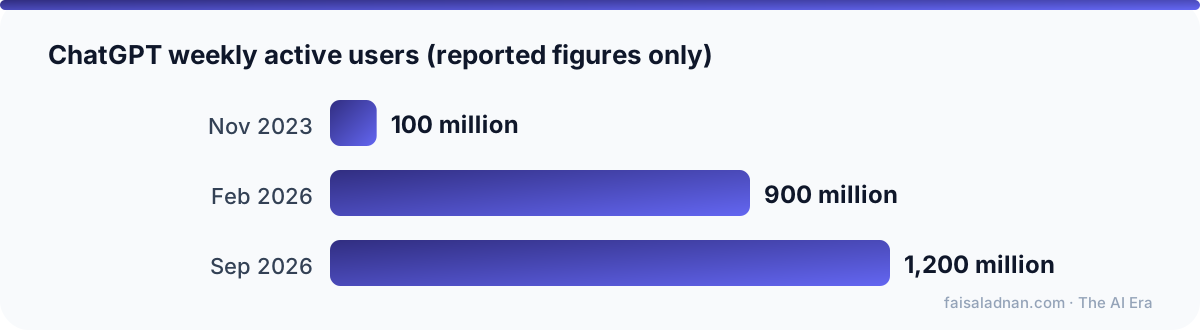
I plotted only the figures that were publicly reported. I did not draw a smooth line between them, because that would imply data nobody has published.
One caution about this number. "Weekly active user" is a measure of reach. A person who asks one homework question and a developer who lives inside the tool all day both count as one. The figure tells you how far the tool has spread. It does not tell you how deeply anyone relies on it, or how well they use it.
In August 2026 Google announced that the Gemini app had passed 1 billion monthly active users. It became the 14th Google product to reach that mark, and Sundar Pichai called it the company's fastest growing product ever. For context, Search, Gmail and Android are on that same list. Those products took years to get there.
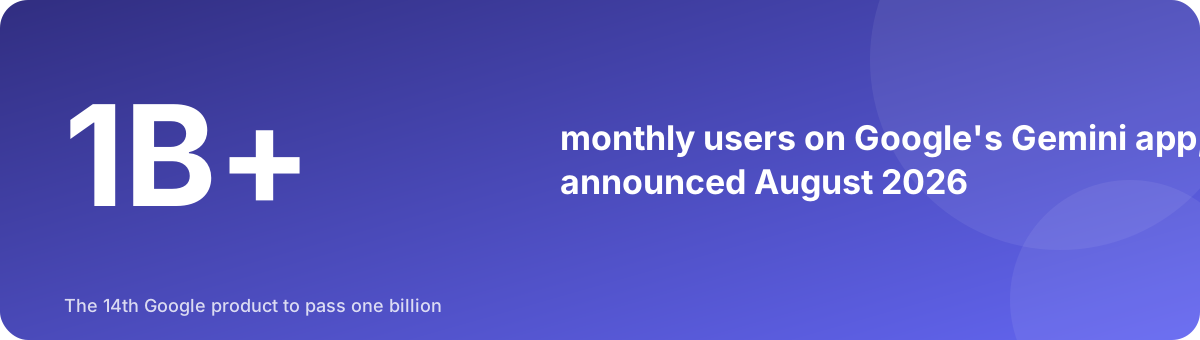
Notice what this means for the market. ChatGPT is not alone at the top. When two or three products each reach a billion people, the technology stops being a novelty and becomes infrastructure, in the same way search engines and email became infrastructure.
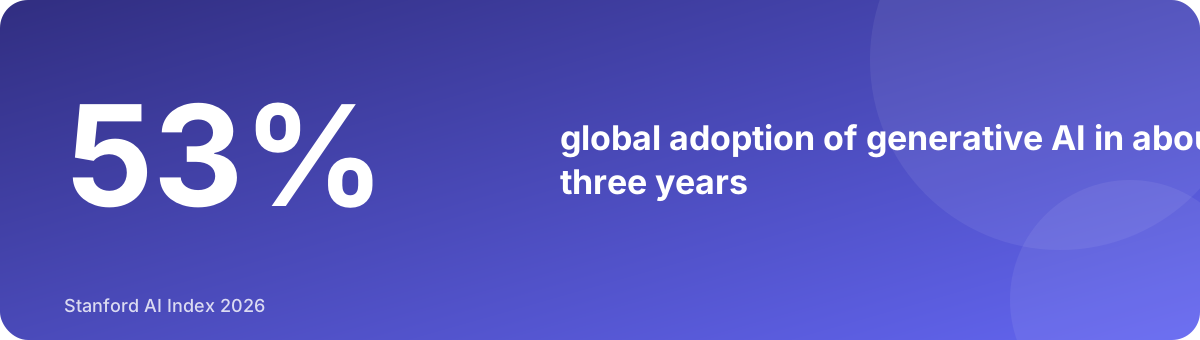
The most useful number in this whole story comes from the Stanford AI Index 2026. It reports that generative AI reached about 53% global adoption in around three years, faster than the personal computer or the internet managed in their own early years. The report is now in its ninth edition and covers research, technical performance, the economy, education, policy and public opinion.
A summary of the report written by the UN University Campus Computing Centre makes another point that I will return to in other posts: industry now builds the overwhelming majority of notable models, more than 90% of them in 2025. The people deciding how this technology gets built are mostly inside companies, not universities. That matters, because company priorities (speed, scale, revenue) are not the same as public priorities (safety, fairness, jobs).
You do not need to be a pioneer to benefit. The hard work of building the models has been done by others, and the tools are cheap or free. Using AI well is already becoming a normal workplace skill, like using Excel or sending a professional email. If you have been waiting for the right moment to start, that moment passed a while ago. Starting now is not early. It is on time.
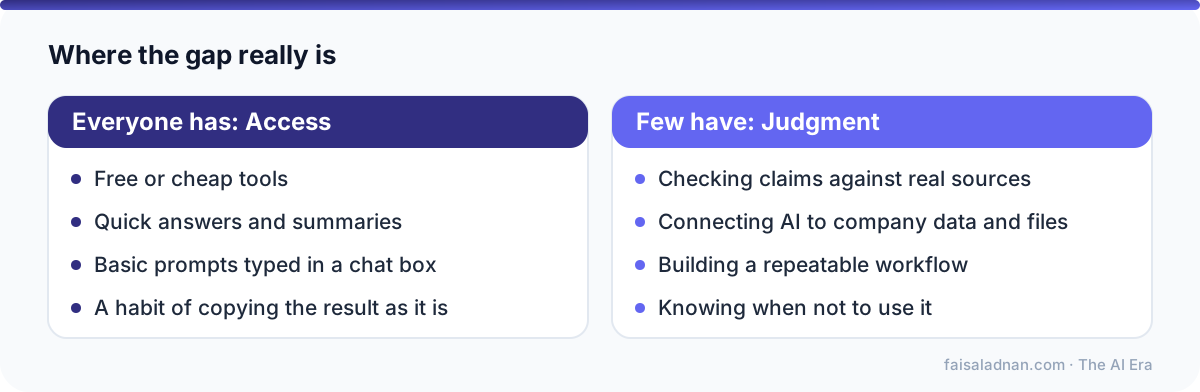
Adoption is wide, but skill is thin. Most people use AI for quick answers. Very few know how to:
Those are the skills that separate an employee who is merely "using AI" from one who is genuinely more productive and more trusted. Almost nobody has them yet, which is why you are not late.
If you do this for a month, you will be ahead of most people who "use AI every day". Not because you found a secret tool, but because you learned to check, correct and improve its work. For a structured path, see my free AI learning roadmap.
See the complete AI Era series

Written by Faisal Adnan
Business Intelligence and AI mentor. I teach Data Analytics, Power BI, Microsoft Fabric, SQL, Python and applied AI, and write about what is changing and what it means for your career.

Written by
Faisal Adnan is a data analytics and AI mentor from Pakistan. He teaches Power BI, Microsoft Fabric, machine learning and applied AI through live classes and 1-on-1 mentorship, and writes in plain language so students and working professionals can follow where AI is heading and what to learn next.
One page that lists every post in The AI Era series, grouped by theme, with a short method for checking any AI claim yourself.
By Faisal Adnan
Free tools to test AI apps, scan them for security problems and learn how models are built, including Playwright, promptfoo, garak, PyRIT, Semgrep and Karpathy's nanochat. Plus a starter plan.
By Faisal Adnan
Open-source tools for no-code AI apps, image and video generation and speech, including Urdu transcription with Whisper, plus a licence warning every builder should read.
By Faisal Adnan