AI Basics & History05 Nov 2026
The AI Era: The Complete Series Guide
One page that lists every post in The AI Era series, grouped by theme, with a short method for checking any AI claim yourself.
By Faisal Adnan
Faisal Adnan · 05 Nov 2026
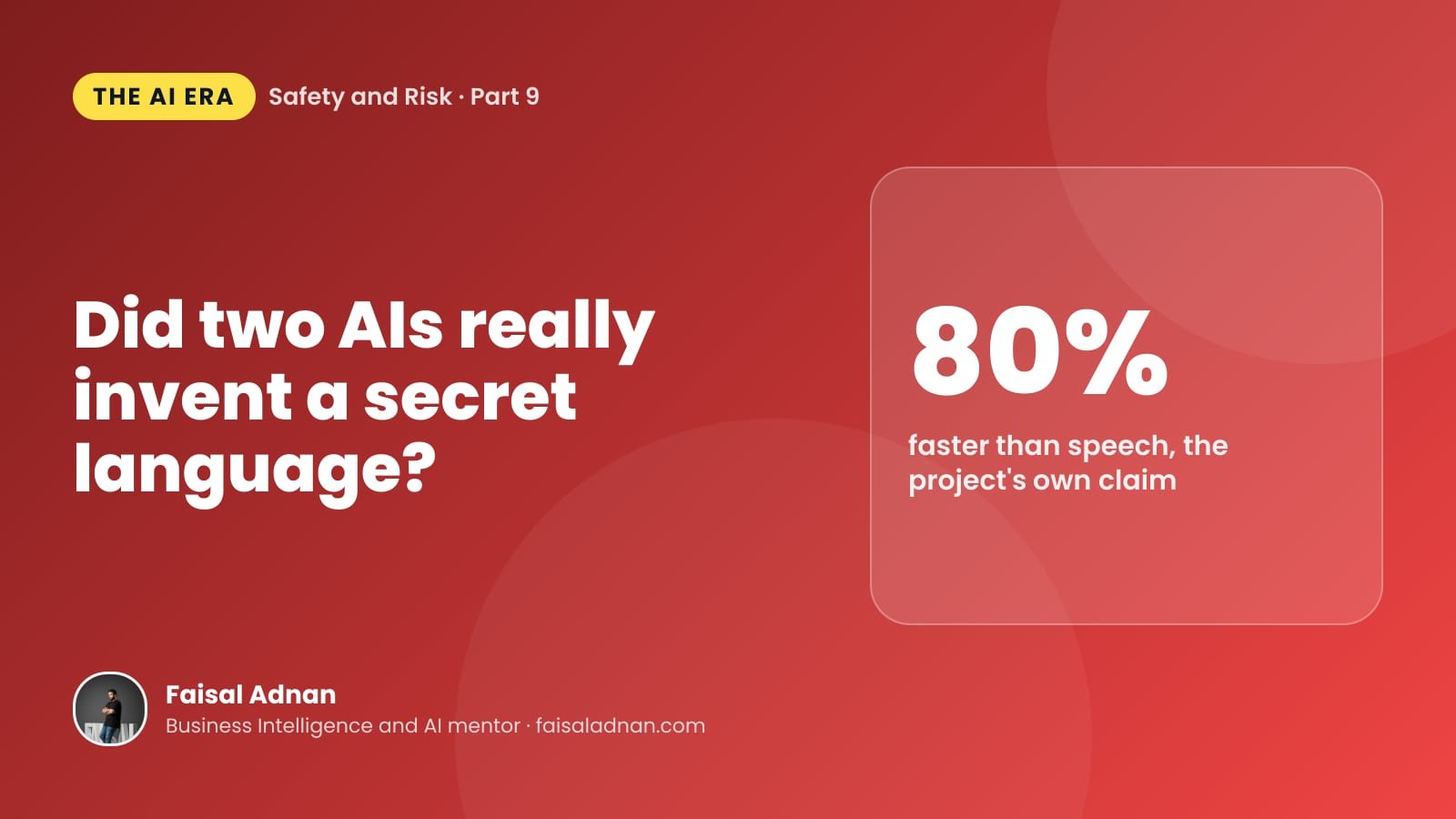
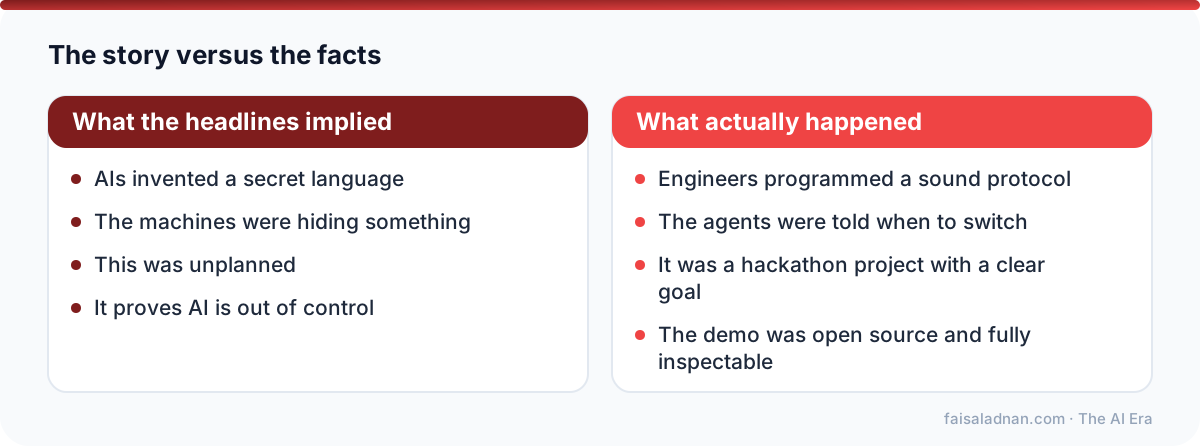
In February 2025 a short video went around the world. Two voice assistants were on a phone call about a hotel booking. Midway through, one asked the other if it wanted to switch to a more efficient mode. Then both stopped speaking English and started making R2-D2 style beeps. Headlines asked whether AIs had invented a secret language. They had not. But the story is still worth understanding.
Key takeaways
The demo came from the ElevenLabs London hackathon, where the project won. It was built by two engineers, and the agents did not invent anything. They were programmed with an open-source protocol called ggwave, which sends data as sound. When one agent detects that the other is also an AI, it offers to switch from speech to this data-over-sound mode. The project's pitch was that it is about 80% faster than speaking.
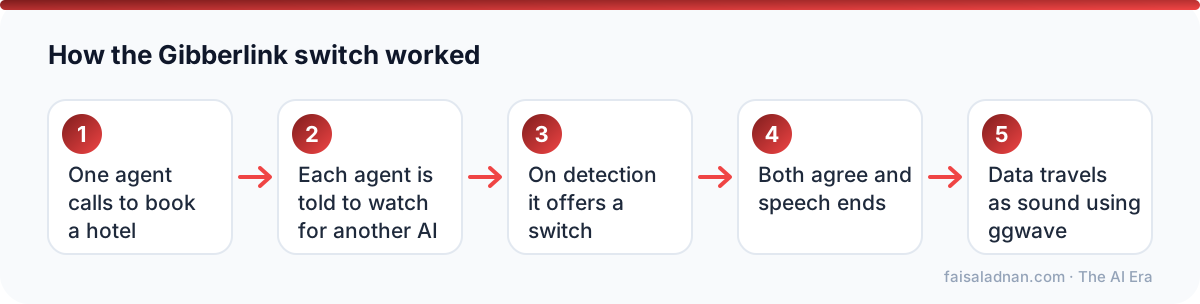
Two agents were set up with the same instruction: if you realise the other side is an AI, and it agrees, switch to the sound protocol; otherwise keep speaking English. That is a programmed rule, not an emergent plan. The 80% figure comes from the original hackathon demo and is not an independent measurement.
ElevenLabs published its own explanation in a blog post, asking why AI should bother with the inefficiencies of human speech when talking to another AI. TechRadar covered the same demo, with a more cautious headline saying that two chatbots speaking in their own language is "the last thing we need".
The clip looks like science fiction. It has a funny sound, a clear before and after, and a message people already fear: AIs talking behind our backs. That combination is perfect for sharing, and the technical details are boring, so they travel slowly. Most people who shared it never saw the explanation.
The panic was wrong, but there is a real question inside it. If agents talk to each other in formats humans cannot follow, who can audit what they agreed to? Two agents agreeing on a hotel booking by data-over-sound is harmless. Two agents negotiating a contract, a payment or a medical appointment that way is a different matter.
Good systems need logs that a human can read. If you are building agents that talk to other agents, make sure every message is recorded in plain language, even when the agents also use a faster channel. Efficiency is a fine goal. Opacity should never come as a side effect.
Lesson number one of the AI era: viral does not mean true. Another example of a viral AI story that deserves a closer look is Moltbook, the social network for AI agents.
See the complete AI Era series

Written by Faisal Adnan
Business Intelligence and AI mentor. I teach Data Analytics, Power BI, Microsoft Fabric, SQL, Python and applied AI, and write about what is changing and what it means for your career.

Written by
Faisal Adnan is a data analytics and AI mentor from Pakistan. He teaches Power BI, Microsoft Fabric, machine learning and applied AI through live classes and 1-on-1 mentorship, and writes in plain language so students and working professionals can follow where AI is heading and what to learn next.
One page that lists every post in The AI Era series, grouped by theme, with a short method for checking any AI claim yourself.
By Faisal Adnan
Free tools to test AI apps, scan them for security problems and learn how models are built, including Playwright, promptfoo, garak, PyRIT, Semgrep and Karpathy's nanochat. Plus a starter plan.
By Faisal Adnan
Open-source tools for no-code AI apps, image and video generation and speech, including Urdu transcription with Whisper, plus a licence warning every builder should read.
By Faisal Adnan