AI Basics & History05 Nov 2026
The AI Era: The Complete Series Guide
One page that lists every post in The AI Era series, grouped by theme, with a short method for checking any AI claim yourself.
By Faisal Adnan
Faisal Adnan · 05 Nov 2026
How long until AI matches human intelligence? You get a different answer from every expert. This post puts the answers side by side, explains why they differ and suggests a way to plan when nobody can agree.
Key takeaways
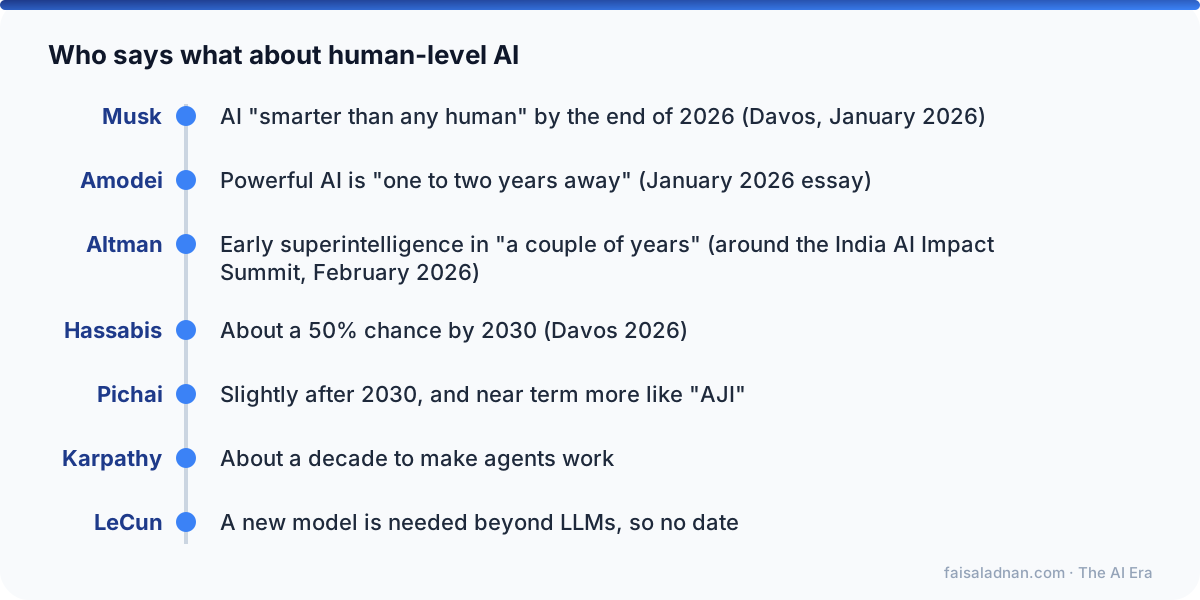
A few notes on the individual views:
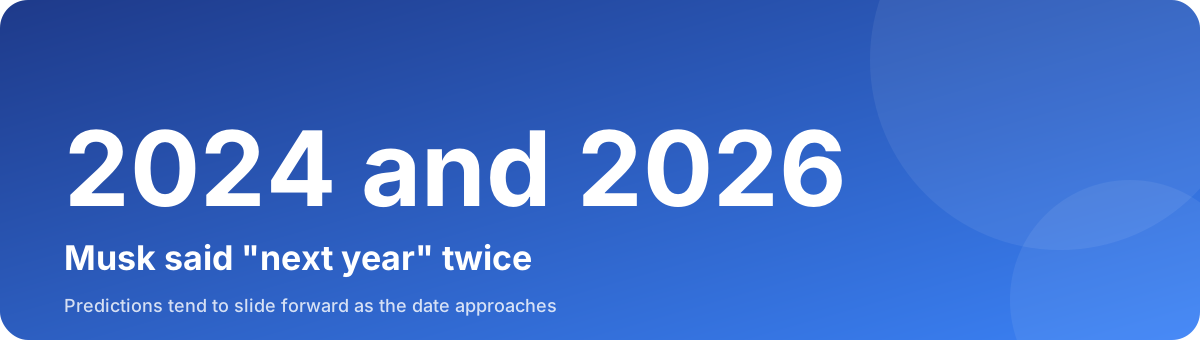
Elon Musk said "next year" in 2024, and said it again in 2026. Predictions move, and they tend to move forward as the date approaches. That does not mean progress is fake. It means precise timelines are the weakest part of this conversation.
"Human-level", "AGI", "powerful AI" and "superintelligence" are not the same thing, and the speakers use them differently. Some mean beating humans on specific tests. Others mean doing most economically valuable work. A date is meaningless without its definition.
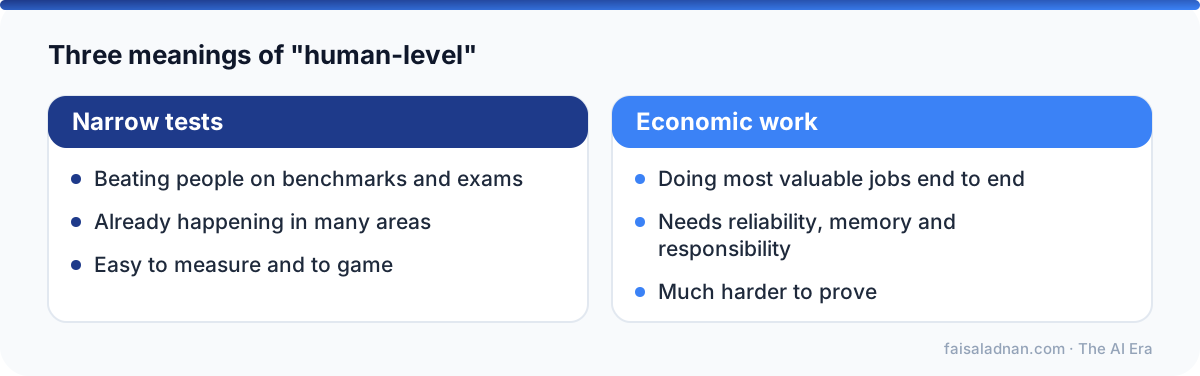
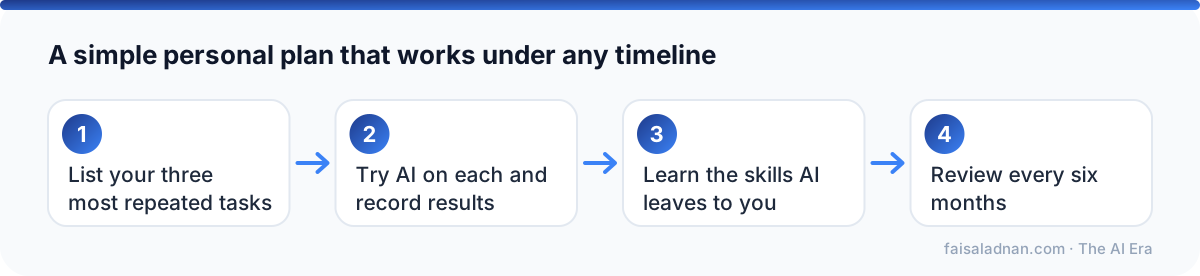
The honest summary is that nobody knows, and the people who know the most disagree the most. That is not a reason to ignore the topic. It is a reason to build skills that pay off in several futures. If you want a place to start, see the free learning roadmap, and to see the cautious voices in more detail, read It's the Decade of Agents, Not the Year.
See the complete AI Era series
Written by Faisal Adnan
Business Intelligence and AI mentor. I teach Data Analytics, Power BI, Microsoft Fabric, SQL, Python and applied AI, and write about what is changing and what it means for your career.

Written by
Faisal Adnan is a data analytics and AI mentor from Pakistan. He teaches Power BI, Microsoft Fabric, machine learning and applied AI through live classes and 1-on-1 mentorship, and writes in plain language so students and working professionals can follow where AI is heading and what to learn next.
One page that lists every post in The AI Era series, grouped by theme, with a short method for checking any AI claim yourself.
By Faisal Adnan
Free tools to test AI apps, scan them for security problems and learn how models are built, including Playwright, promptfoo, garak, PyRIT, Semgrep and Karpathy's nanochat. Plus a starter plan.
By Faisal Adnan
Open-source tools for no-code AI apps, image and video generation and speech, including Urdu transcription with Whisper, plus a licence warning every builder should read.
By Faisal Adnan