AI Basics & History05 Nov 2026
The AI Era: The Complete Series Guide
One page that lists every post in The AI Era series, grouped by theme, with a short method for checking any AI claim yourself.
By Faisal Adnan
Faisal Adnan · 05 Nov 2026
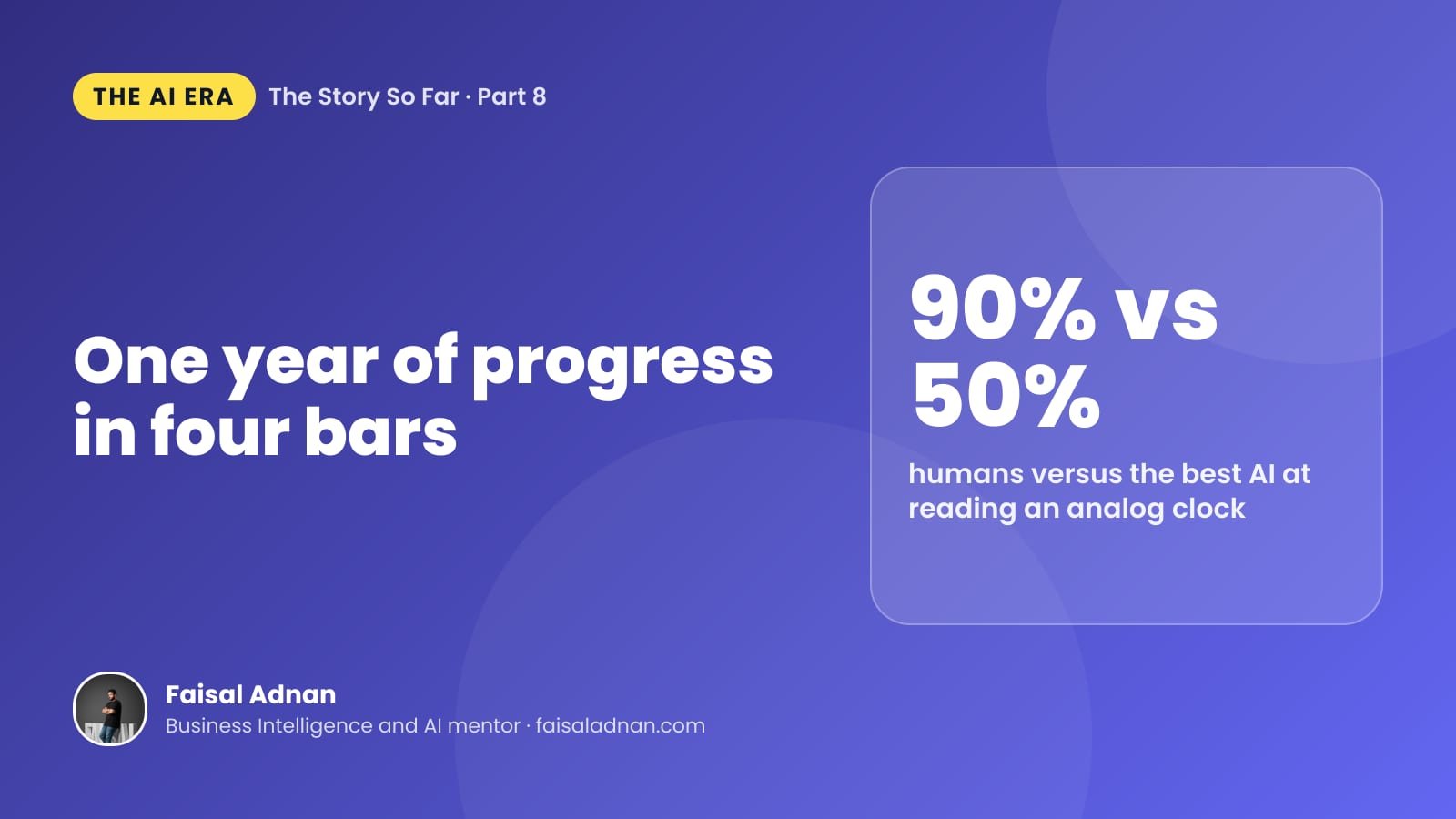
Statistics about AI progress can feel unreal, because they come from tests most of us have never seen. So this post tries to make four of them concrete, and then adds a fifth that humbles the rest. The numbers come from the Stanford AI Index 2026 as summarised in public write-ups.
Key takeaways
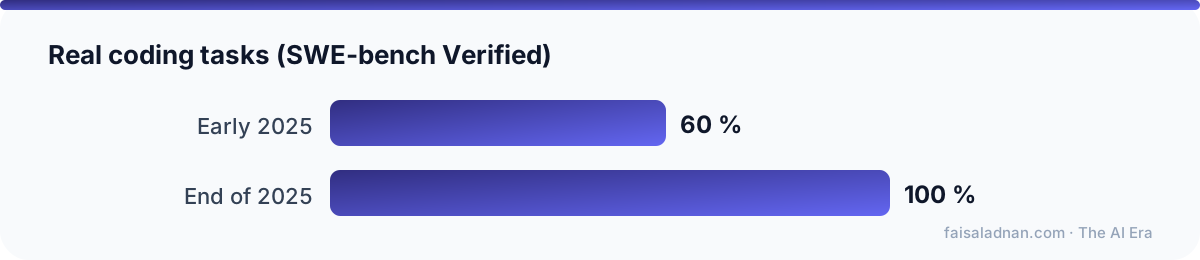
Real coding tasks (SWE-bench Verified). This benchmark gives a model real bug reports from open-source projects and checks whether its fix makes the tests pass. Scores went from around 60% in early 2025 to close to 100% by the end of the year.
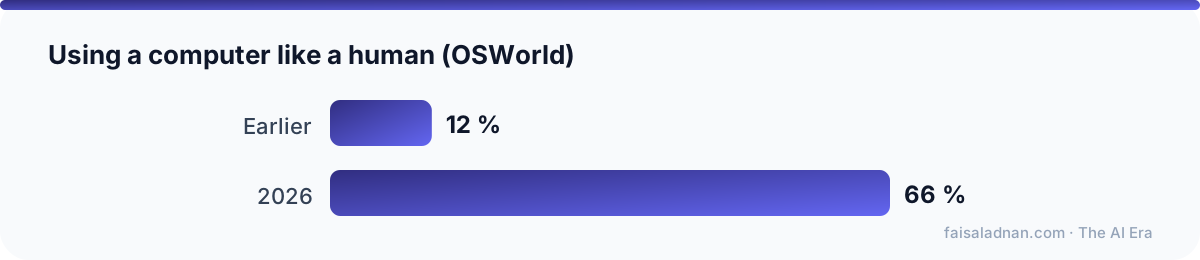
Using a computer like a human (OSWorld). Here a model has to complete tasks by looking at a screen and using a mouse and keyboard. Scores rose from about 12% earlier to 66% in 2026.
Humanity's Last Exam. A set of very hard questions written by experts, designed to stay difficult for a long time. It went from 8.8% in early 2025 to 46% in April 2026.
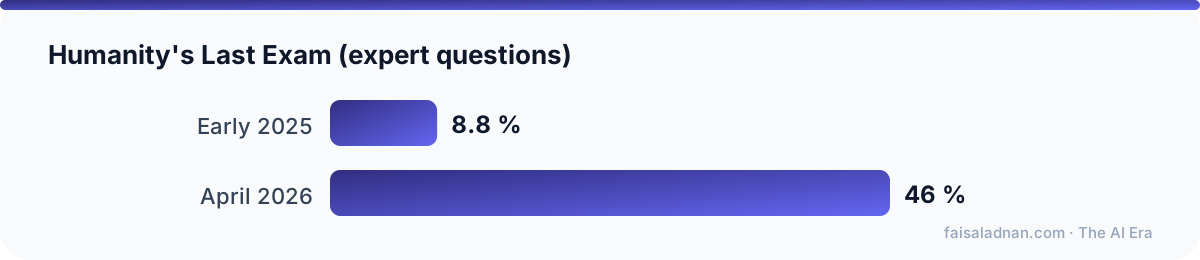
A summary of the Index by an engineering lead, Maksim Danilchenko, puts the same trend in a wider frame: about $581 billion of global corporate AI investment, a US-China performance gap of just 2.7%, and entry-level developer hiring down almost 20% since 2024. The UN University Campus Computing Centre's summary adds that industry now produces more than 90% of the notable models.
Here is the data point I like to share most. Humans read an analog clock correctly about 90% of the time. The best AI scores around 50%. Robots, meanwhile, still fail roughly nine out of ten real household tasks.
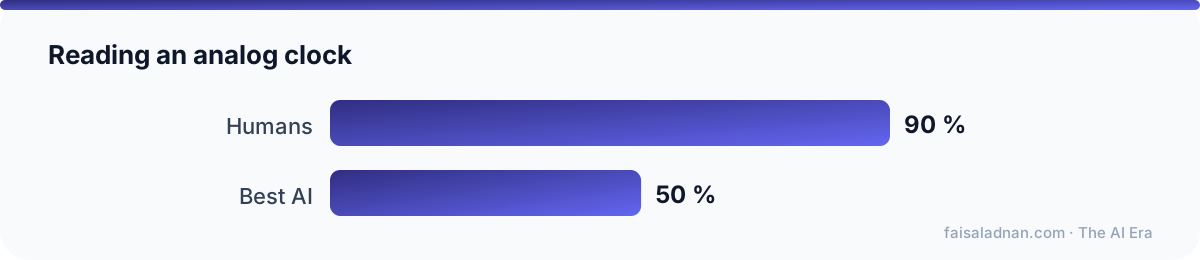
Google's CEO Sundar Pichai has a name for this pattern: AJI, Artificial Jagged Intelligence. In an interview he described how AI can be brilliant on one task and clumsy on the next, and that in the short term reality may be closer to AJI than to AGI. Imagine a line graph of ability across all tasks. For a person it is a gentle hill. For today's AI it looks like a mountain range, with peaks of genius next to valleys of silliness.
If you only see the first three bars, you may think AI will do everything. If you only see the clock, you may think it is a toy. Both are wrong. The skill to build is knowing where the edge is for the tool you are using right now.
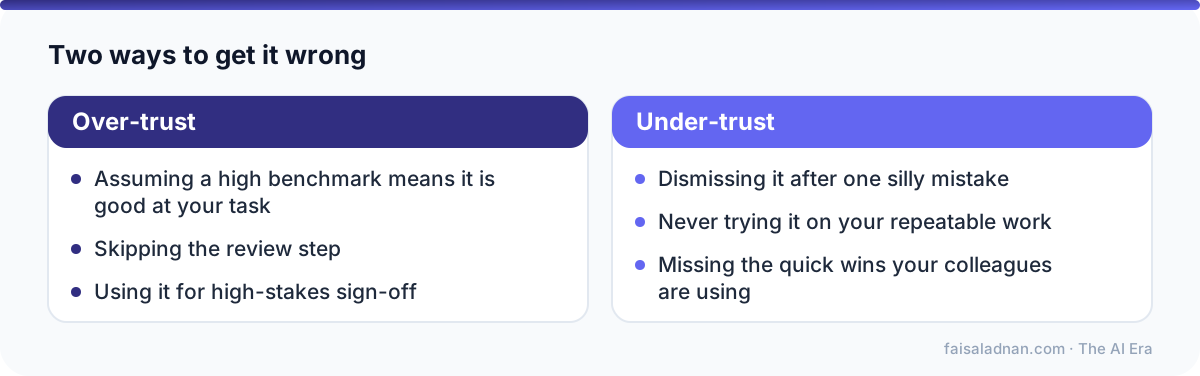
The benchmarks will keep rising, and the clock-style failures will keep appearing in new places. If you learn to measure the edge yourself, you will not be surprised in either direction. To see how the leaders themselves disagree about where this is heading, read Ask Ten Leaders, Get Ten Timelines.
See the complete AI Era series

Written by Faisal Adnan
Business Intelligence and AI mentor. I teach Data Analytics, Power BI, Microsoft Fabric, SQL, Python and applied AI, and write about what is changing and what it means for your career.

Written by
Faisal Adnan is a data analytics and AI mentor from Pakistan. He teaches Power BI, Microsoft Fabric, machine learning and applied AI through live classes and 1-on-1 mentorship, and writes in plain language so students and working professionals can follow where AI is heading and what to learn next.
One page that lists every post in The AI Era series, grouped by theme, with a short method for checking any AI claim yourself.
By Faisal Adnan

Free tools to test AI apps, scan them for security problems and learn how models are built, including Playwright, promptfoo, garak, PyRIT, Semgrep and Karpathy's nanochat. Plus a starter plan.
By Faisal Adnan
Open-source tools for no-code AI apps, image and video generation and speech, including Urdu transcription with Whisper, plus a licence warning every builder should read.
By Faisal Adnan